How do foldable phone screens work?
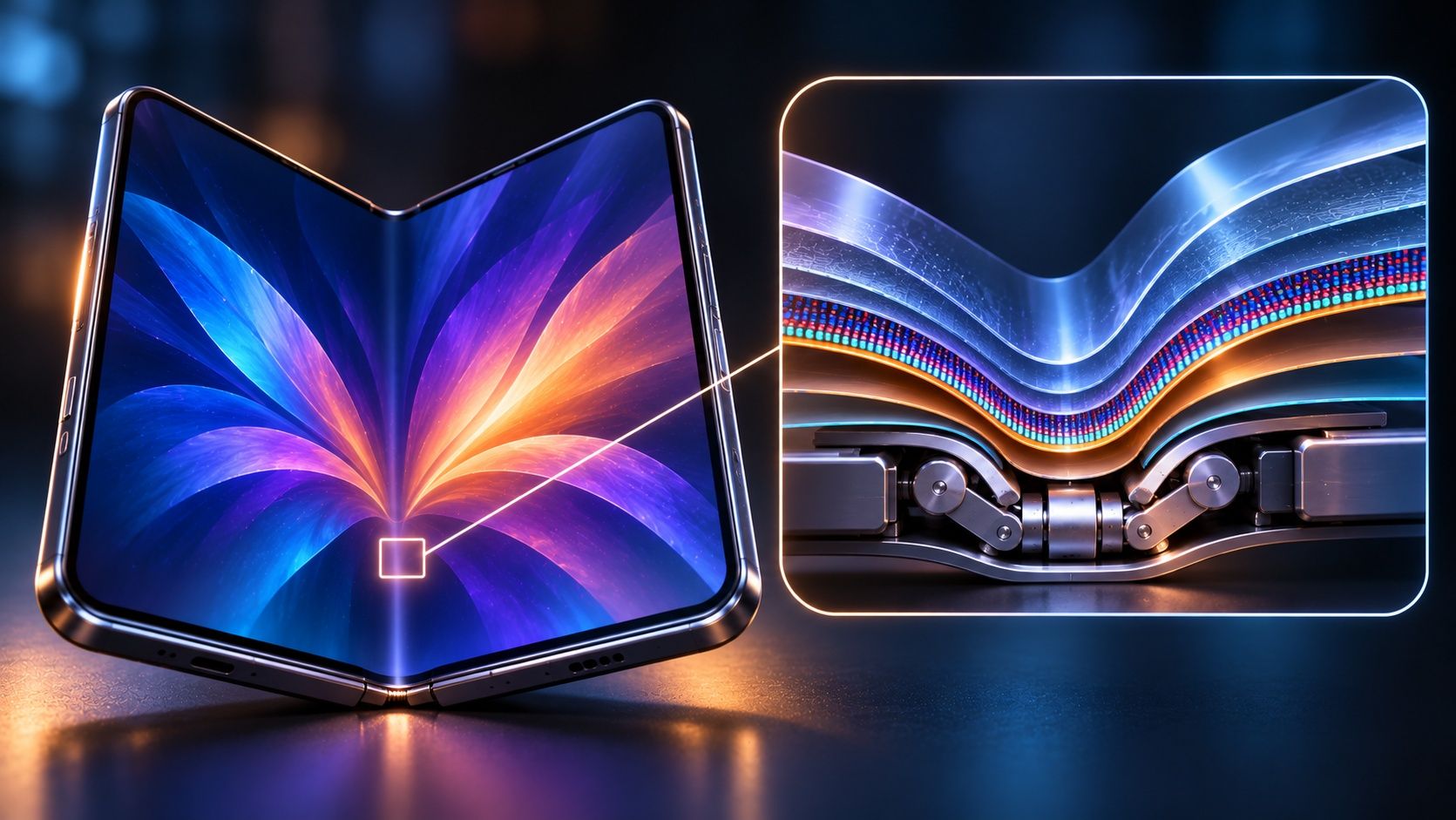
A foldable screen is a flexible OLED display, made of layers thinner than a hair, on a plastic base instead of rigid glass. On top sits ultra-thin glass that bends. A clever hinge lets the fold curve gently in a teardrop shape instead of creasing sharply, so the layers never bend tighter than they can handle.
Pixels that bend
Normal screens are built on rigid glass. A foldable uses OLED, where every pixel makes its own light, printed on a thin plastic sheet. Without a stiff backlight behind it, the whole stack can bend.
Share this stepGlass so thin it flexes
The top layer is ultra-thin glass, around 30 micrometers, thinner than a hair. Glass that thin can bend without cracking, and it feels more like glass than the soft plastic used on the first foldables.
Share this stepThe hinge gives the fold room
When the phone closes, the hinge pulls the screen into a rounded teardrop shape inside the body instead of a sharp crease. Gears and plates support the screen so it never bends tighter than its layers can take.
Share this stepThin layers and a gentle curve, not a sharp fold.
Flexible OLEDultra-thin glassclever hinge
Manufacturers test the hinges for hundreds of thousands of folds, roughly years of normal use. The faint crease you can see in the middle comes from the layers being slightly stretched and squeezed at the same spot every time.
Common follow-up questions
Why is there a crease in the middle?
Each fold stretches the outer layers and squeezes the inner ones at the same spot. Over time that leaves a faint line, more visible at an angle than straight on. Newer hinges make it less noticeable.
How many times can you fold it?
Makers usually test around 200,000 to 500,000 folds, which is many years of opening and closing a phone dozens of times a day.
Is a foldable screen more fragile?
The inner screen is softer than a normal phone screen and scratches more easily, so sharp objects and fingernails can leave marks. Dust and sand in the hinge are a bigger risk than folding.
Should I remove the screen protector?
No. On most foldables the protective film is part of the screen and should only be replaced by a repair shop.