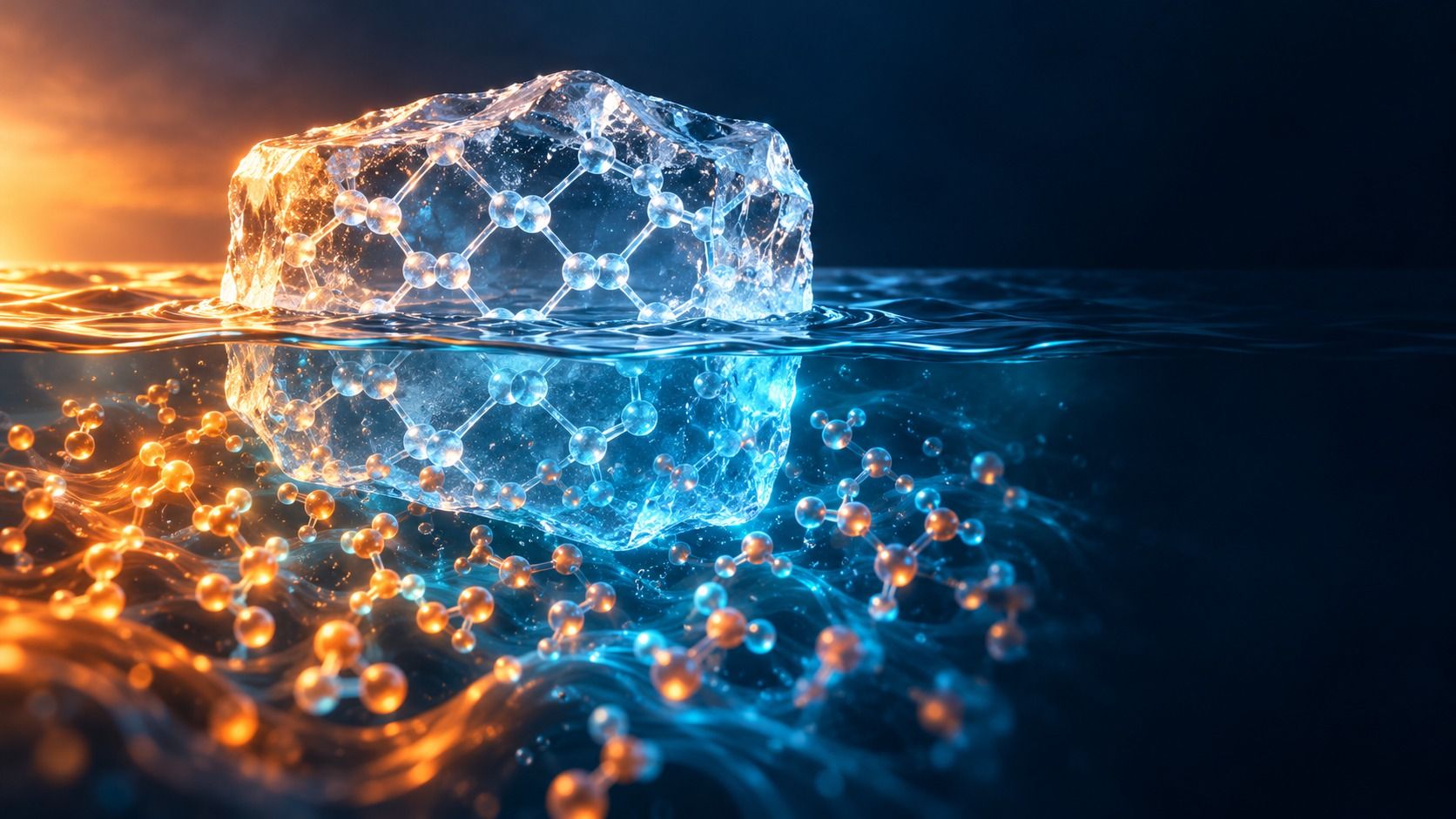
Why does ice float on water?
When water freezes, its molecules lock into an open, honeycomb-like pattern with empty space in between. That makes ice about 9 percent lighter than the same amount of liquid water, so it floats.
In water, molecules tumble close together
In liquid water, the molecules move around freely, constantly bumping into each other and packing tightly. That makes liquid water fairly dense.
Share this stepFreezing locks them into a honeycomb
As water cools to 0 °C (32 °F), each molecule grabs onto its neighbors in a fixed, six-sided pattern. That pattern holds the molecules slightly apart, leaving open space inside the crystal.
Share this stepMore space means lighter, so it floats
The same amount of water takes up about 9 percent more space as ice. Because ice is lighter for its size than liquid water, the water pushes it up, and roughly one tenth sticks out above the surface.
Share this stepWater is the odd one out.
Cold wateropen crystalfloating ice
Almost every other substance gets denser when it freezes, so its solid sinks. Because ice floats, lakes freeze from the top down, and the ice layer insulates the water below so fish survive the winter.
Common follow-up questions
Why do frozen bottles crack?
Water expands by about 9 percent as it freezes. In a closed bottle or pipe there’s nowhere for it to go, so it pushes until something breaks.
How much of an iceberg is underwater?
About 90 percent. Only around a tenth sticks out above the surface, which is where the phrase “tip of the iceberg” comes from.
Does ice float in all liquids?
No. Ice sinks in liquids that are lighter than it, like pure alcohol or oil. Try dropping an ice cube in a glass of vodka.
Why don’t lakes freeze solid?
Water is densest at about 4 °C (39 °F), so that water sinks to the bottom while colder water and ice stay on top and insulate it.