Why can’t some people picture things?
Some people can’t create pictures in their mind at all, a condition called aphantasia. Ask them to imagine an apple and they know what an apple is, but they don’t see one. It’s not a disorder, just a difference in how the brain connects memory and visual areas. Roughly 1 to 4 percent of people have it.
Picture an apple
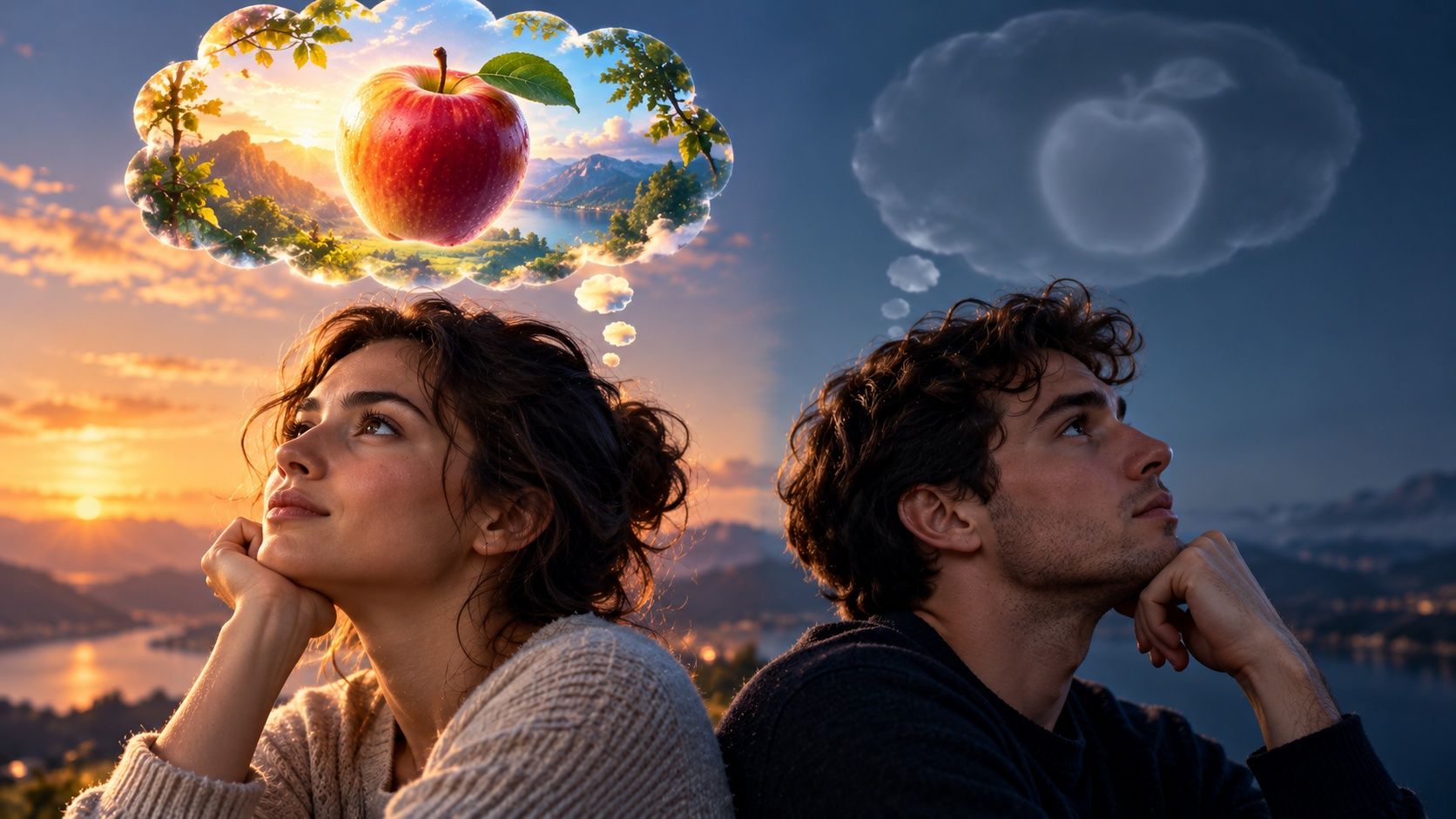
Close your eyes and imagine an apple. Some people see it clearly, with color, shine and a leaf. Others see a blurry shape. And some see nothing at all, just a dark field, even though they know exactly what an apple looks like.
Share this stepIt depends on how brain areas talk
When you imagine something, your memory and planning areas send signals back to the visual areas at the back of the brain, as if you were looking. Brain scans suggest that in people with aphantasia, that connection is weaker.
Share this stepThey think in other ways
People with aphantasia remember facts, words and feelings instead of images. Many are scientists, engineers or writers, and many only find out as adults that others literally see pictures.
Share this stepTwo minds, same apple, different pictures.
Vivid imageno imageboth are normal
The name aphantasia was coined in 2015. At the other end of the scale is hyperphantasia, where mental images feel almost as real as seeing. Most people fall somewhere in between.
Common follow-up questions
Is aphantasia a disorder?
No. It’s a variation in how people experience their thoughts, not a disease. Most people with it live completely normal lives.
Do people with aphantasia dream in pictures?
Many do. Dreams seem to work differently from deliberate imagining, so some people with aphantasia still have visual dreams.
Can you train yourself to visualize?
There’s little evidence that it can be learned. Some people report small changes, but research is still early.
How do I know if I have it?
Try the apple test: if you see nothing at all when imagining a familiar object or face, you may have aphantasia. Many people only realize it when they compare with others.