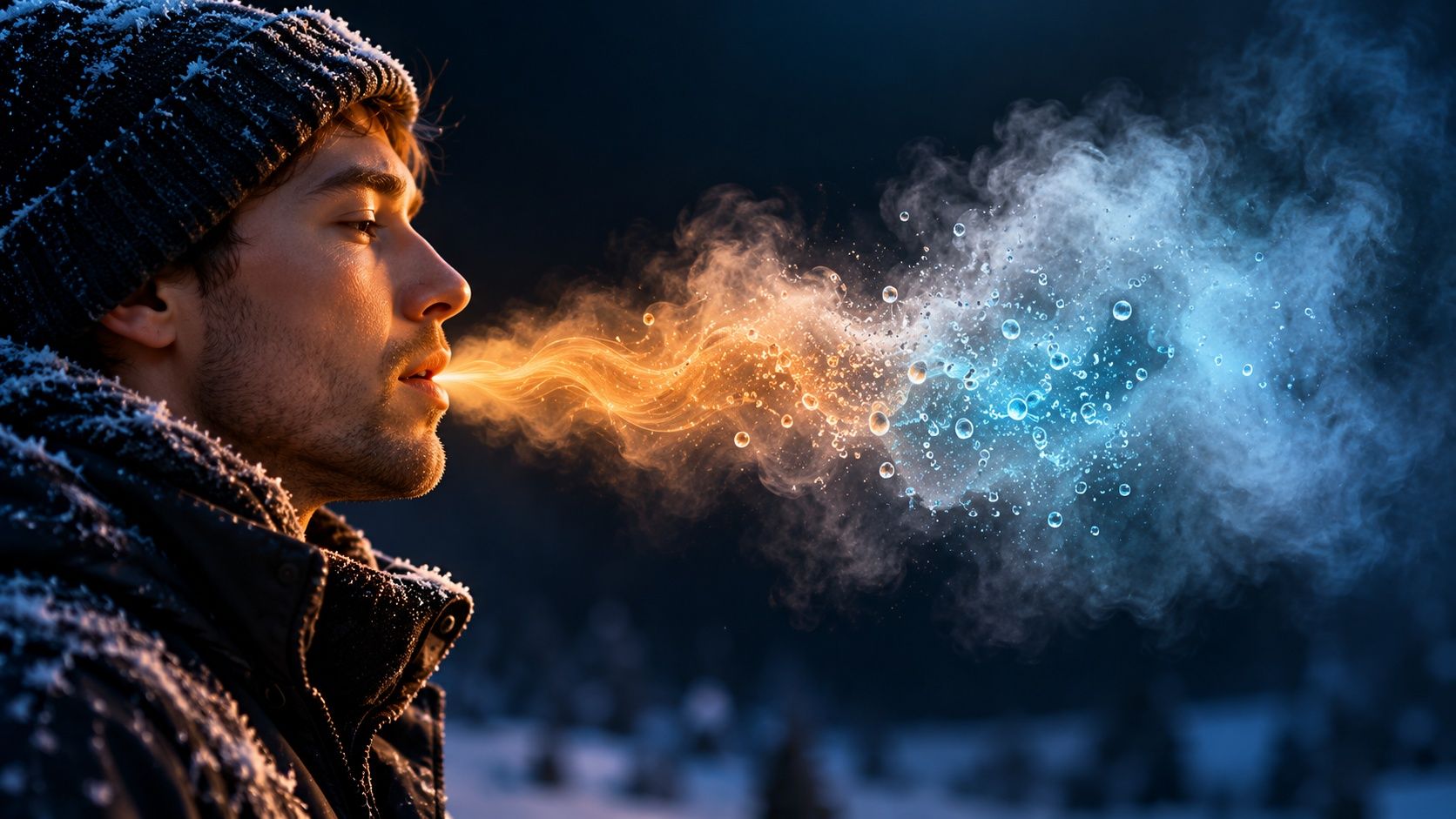
Why can you see your breath when it’s cold?
Your breath is warm and full of invisible water vapor. When it hits cold air, it cools so fast that the vapor turns into millions of tiny water droplets, a small cloud you can see.
Your breath is warm and damp
Air leaves your lungs at about body temperature and almost fully loaded with water vapor. You can’t see the vapor, because it’s a gas.
Share this stepCold air chills it in an instant
When the warm breath mixes with freezing air, it cools down within a split second. Cold air can hold far less water vapor than warm air, so the vapor has nowhere to go.
Share this stepThe vapor turns into a tiny cloud
The extra vapor condenses into millions of tiny water droplets. They scatter light, so suddenly you see them, the same way clouds and fog form. A moment later they mix with drier air and evaporate again.
Share this stepYou’re making a tiny cloud.
Warm, damp breathcold airmini cloud
It isn’t smoke or frozen air. It’s liquid water droplets, exactly what clouds are made of. The colder and damper the air, the bigger and longer-lasting your cloud.
Common follow-up questions
At what temperature can you see your breath?
There’s no single number. It often shows below about 7 °C (45 °F), but on damp days you can see it in milder weather, and in very dry air it takes colder temperatures.
Why does it disappear so quickly?
The droplets mix with the surrounding air, which is usually drier, and they evaporate back into invisible vapor within a second or two.
Is it the same as smoke?
No. Smoke is tiny particles from burning. Breath fog is only water, and it leaves nothing behind.
Why do my glasses fog up when I wear a mask in the cold?
Your warm, damp breath escapes upward and hits the cold lenses. The vapor condenses on them the same way it does in the air.