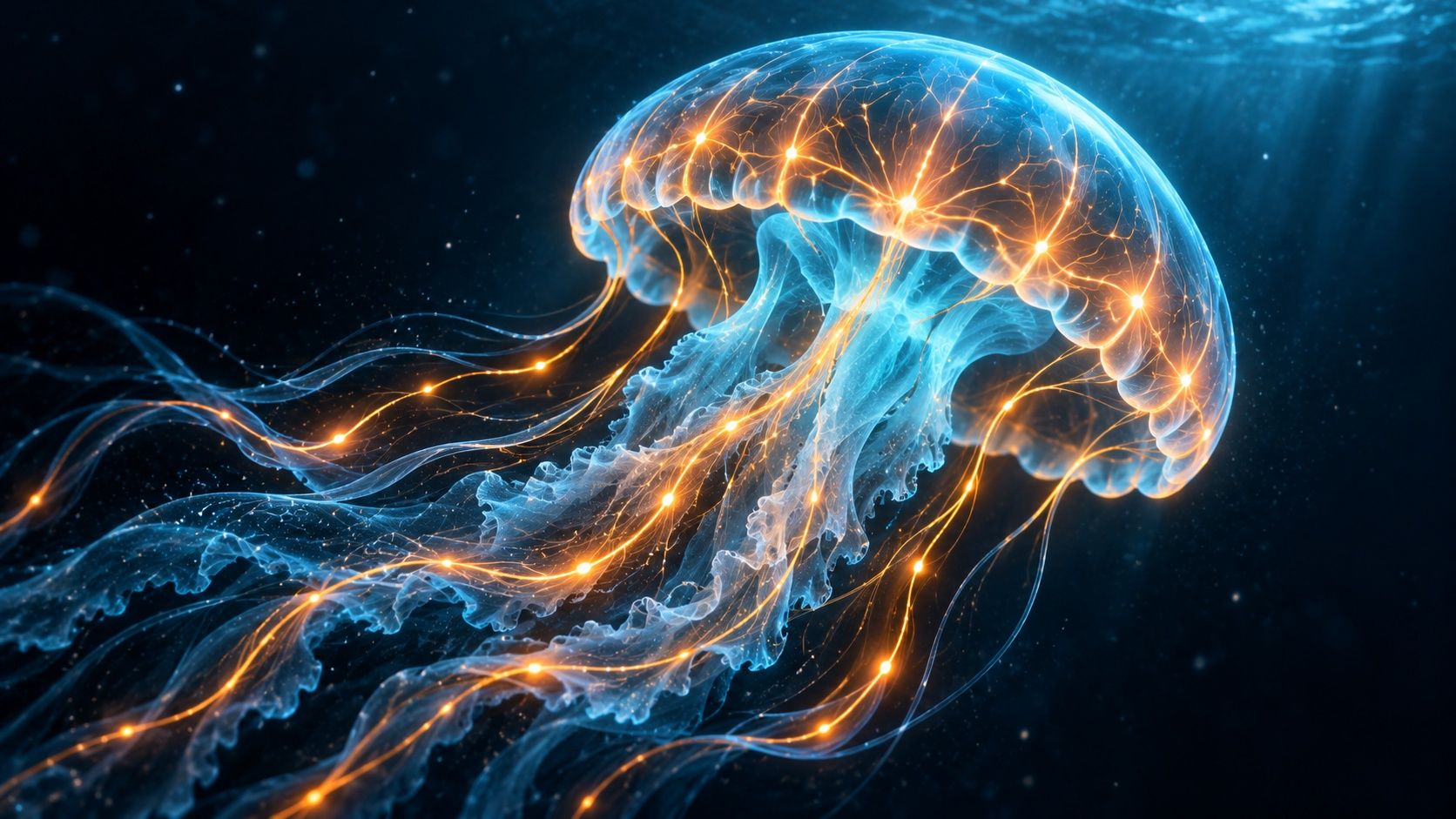
How do jellyfish live without a brain?
Instead of a brain, a jellyfish has a nerve net spread through its whole body, plus small sensors around the edge of its bell. Simple reflexes handle swimming, steering and stinging. Its body is so thin that oxygen seeps straight in, so it needs no heart or blood either.
A net instead of a brain
Nerve cells are spread like a mesh across the whole body, with no control center. A signal in one spot travels outward in all directions, so the whole body can react together.
Share this stepSensors around the edge keep the beat
Small clusters around the edge of the bell sense light and which way is down. They set the rhythm of the pulses: the bell squeezes, pushes water out and glides forward, over and over.
Share this stepTentacles sting on autopilot
The tentacles are lined with tiny harpoon cells. When something touches them, they fire on their own, no decision needed. That’s why even a dead jellyfish or a loose tentacle can sting.
Share this stepNo brain, no heart, no blood, and 500 million years old.
Nerve netsimple reflexesjellyfish
A jellyfish is about 95 percent water and so thin that oxygen seeps straight in from the sea. The design is so simple and robust that jellyfish have drifted through the oceans since long before dinosaurs.
Common follow-up questions
Do jellyfish feel pain?
They react to touch and harm, but with no brain to process it, most scientists think they don’t experience pain the way we do. It’s still debated.
What should I do if I get stung?
Get out of the water, rinse with seawater, not fresh water, and carefully remove any tentacles with a card or tweezers. Seek medical help for severe pain, a large reaction or trouble breathing.
Is there really an immortal jellyfish?
Yes, one tiny species can turn back into its young polyp stage when stressed or injured, starting its life cycle over.
How do jellyfish eat?
Prey that gets stung is pulled up by the tentacles into a single opening under the bell, which works as both mouth and exit.