How does the human eye work?
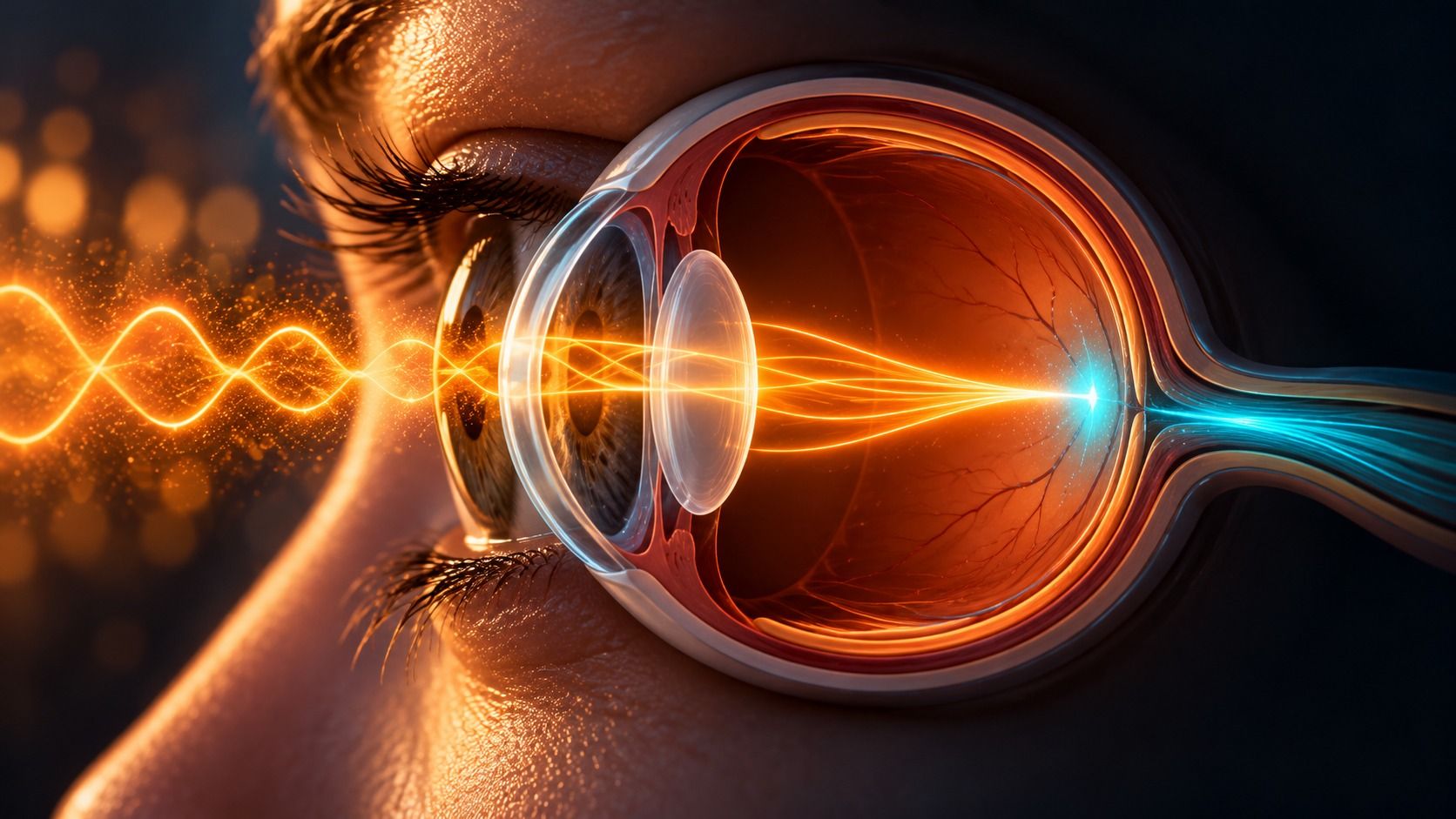
The cornea and lens bend incoming light into a sharp image on the retina at the back of your eye. Cells there turn the light into signals, and your brain turns those signals into what you see.
The clear front bends the light
Light enters through the cornea, the clear dome at the front of your eye. Its curved shape does most of the work of bending the light inward.
Share this stepThe lens fine-tunes the focus
Behind the pupil sits the lens. Tiny muscles change its shape, rounder for things up close and flatter for things far away, so the image stays sharp.
Share this stepThe retina turns light into signals
The light lands on the retina, a thin layer at the back of the eye packed with millions of light-sensitive cells. Rods help you see in dim light, and cones pick up color and fine detail.
Share this stepYour brain does the seeing
The signals travel along the optic nerve to your brain. The image on the retina is actually upside down, and your brain quietly flips it the right way up.
Share this stepYour eyes collect light. Your brain sees.
Lighteyebrainsight
Where the optic nerve leaves the eye there are no light-sensitive cells, so each eye has a small blind spot. You never notice it, because your brain fills in the gap.
Common follow-up questions
Why do some people need glasses?
If the eye is slightly too long or too short, or the cornea is unevenly curved, the light focuses in front of or behind the retina. Glasses bend the light a little extra so it lands in the right spot.
Is the image in my eye really upside down?
Yes. The lens flips the image, just like a camera lens. Your brain learns early on to interpret it the right way up.
How do we see color?
Most people have three types of cones, sensitive to red, green and blue light. Your brain mixes their signals into every color you see.
Why can’t I see colors well in the dark?
In dim light the cones barely respond, so you rely on rods, which only see in shades of gray.