How does lightning happen?
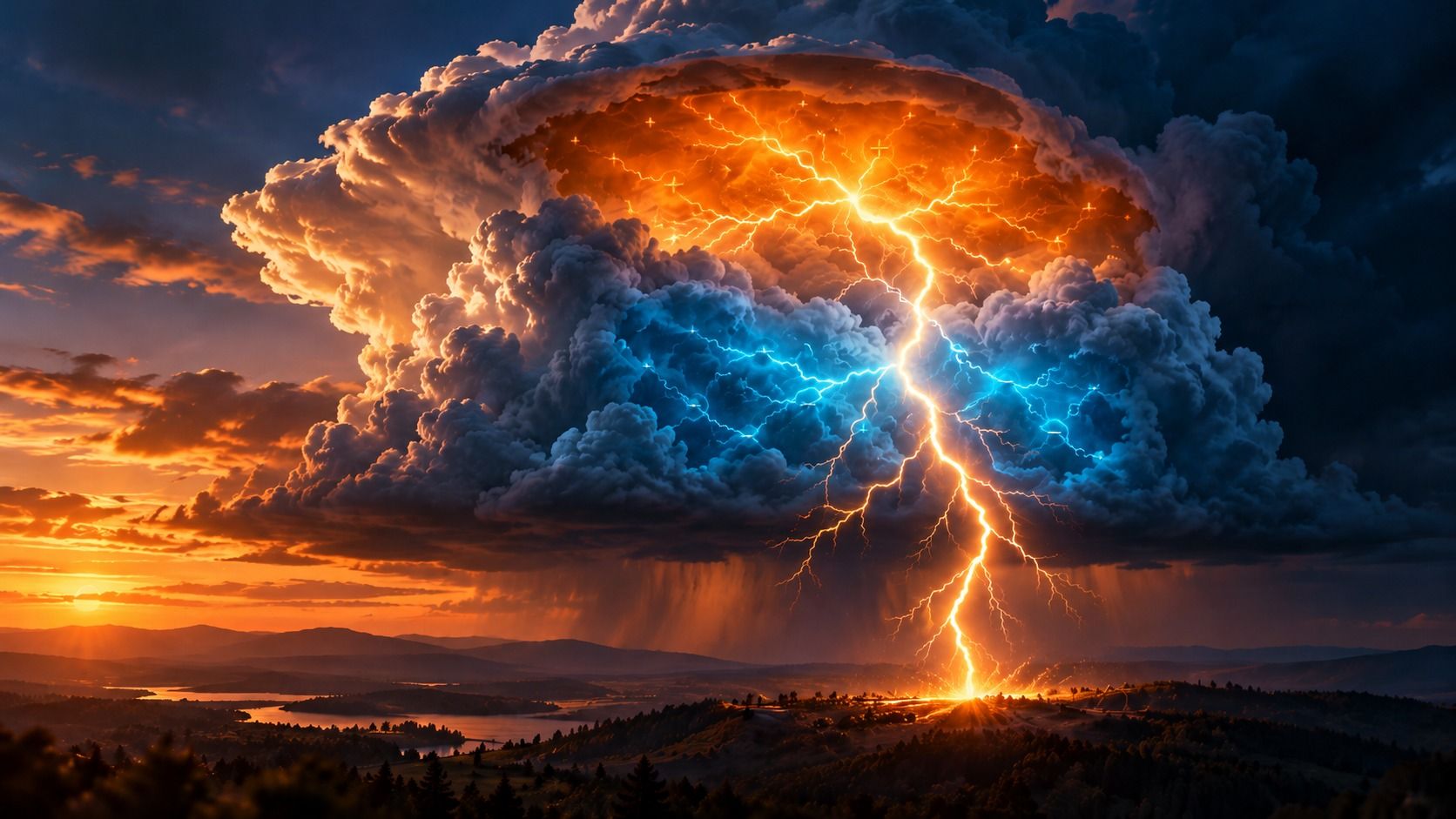
Inside a storm cloud, colliding ice separates electric charge: positive at the top, negative at the bottom. When the difference gets big enough, it discharges in a giant spark, and that’s lightning.
Ice crashes together inside the cloud
Strong winds push water droplets high into the freezing top of a storm cloud. Small ice crystals and heavier soft hail collide millions of times, and each bump rubs off a tiny bit of electric charge.
Share this stepThe cloud becomes a giant battery
Light ice crystals carry positive charge up to the top. Heavier hail carries negative charge down to the bottom. The ground below starts to build up positive charge too.
Share this stepThe tension snaps
Air normally blocks electricity, but when the charge gets strong enough, a path breaks through. A huge current rushes down in a fraction of a second, heating the air to around 27,000 °C (50,000 °F), about five times hotter than the surface of the sun.
Share this stepThunder is the sound of lightning.
Icechargelightning
The air heats so fast it explodes outward, and that blast is thunder. Light arrives almost instantly, sound much slower: every 3 seconds between flash and bang is about 1 km (5 seconds is about 1 mile).
Common follow-up questions
Does lightning ever strike the same place twice?
Yes, often. Tall, pointed objects get hit again and again. The Empire State Building is struck around 20 to 25 times a year.
Am I safe in a car during a storm?
Yes, in a car with a metal roof. The current flows around the outside of the metal body and into the ground. It has nothing to do with the rubber tires.
Why does lightning zigzag?
The spark feels its way down in short steps, each one jumping to wherever the air conducts best. The result is a jagged, branching path.
What should I do if I’m caught outside?
Get indoors or into a car as soon as you hear thunder. Avoid open fields, hilltops, water and lone trees, and wait about 30 minutes after the last thunder before going back out.