How does a microwave heat food?
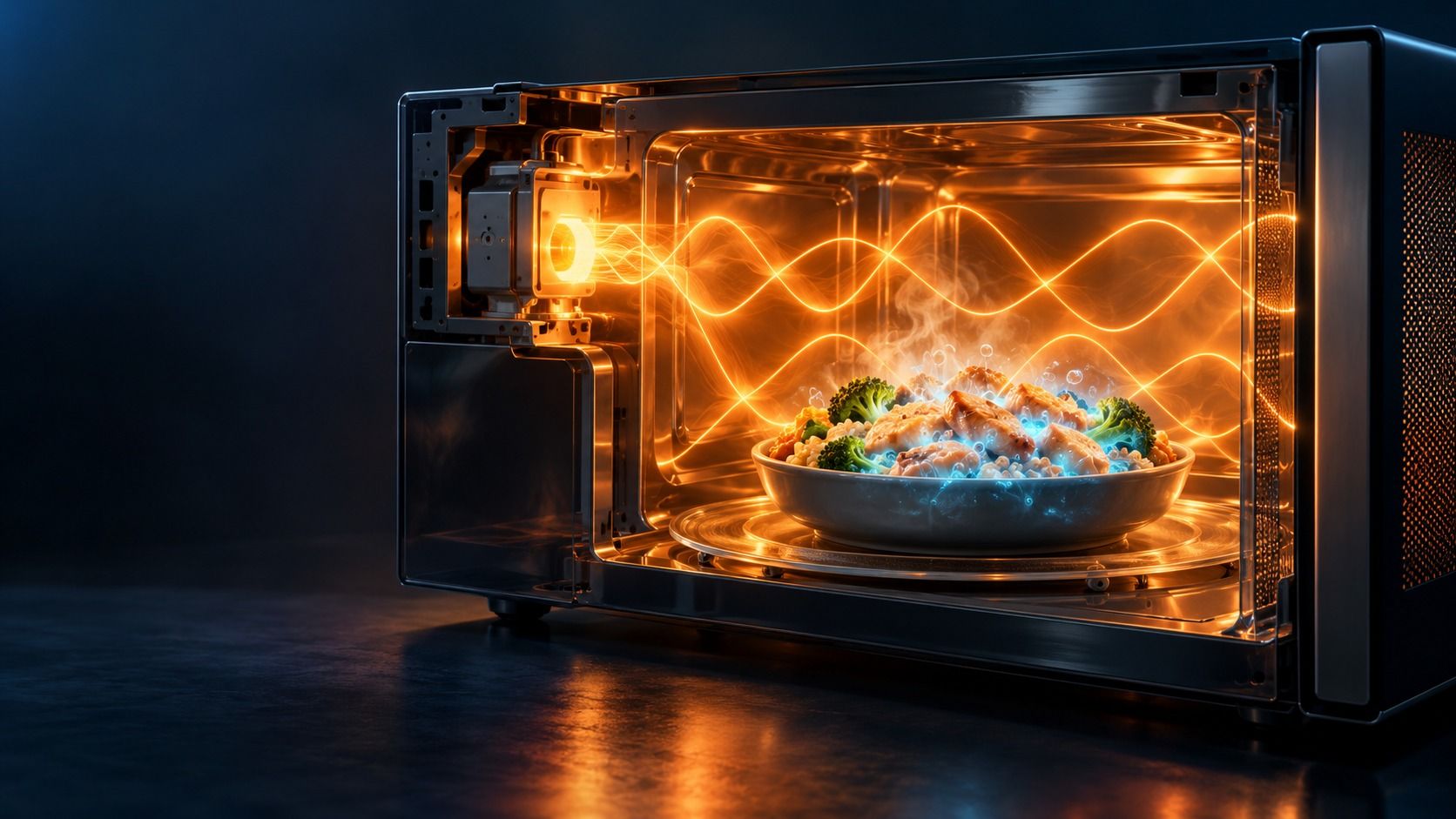
Microwaves make the water molecules in your food twist back and forth billions of times a second. All that motion turns into heat.
Electricity becomes invisible waves
A part called the magnetron turns electricity into microwaves, a type of radio wave.
Share this stepThe waves bounce around
The waves stream into the oven and bounce off the metal walls. The mesh in the door lets light out but keeps the waves in.
Share this stepThe water starts to wiggle
Water molecules twist in time with the waves, billions of times a second, and that motion becomes heat. A microwave doesn’t cook from the inside out: the waves only reach a few centimeters (about an inch) in.
Share this stepThat’s why the plate turns.
Microwaveswaterheat
The waves leave some spots hotter than others. The turntable moves the food through them so it heats more evenly. Still, stir halfway through.
Common follow-up questions
Are microwaves dangerous?
No. Microwaves are a type of radio wave, not nuclear radiation. Your food doesn’t become radioactive, and the mesh in the door keeps the waves inside.
Why can’t you put metal in a microwave?
The waves push electrons around in the metal. At thin edges and sharp points that can cause sparks.
Why is the middle sometimes cold?
The waves only reach a few centimeters in. The rest heats slowly as warmth spreads inward, which is why you should let food stand for a minute.
Does microwaving destroy nutrients?
No more than other cooking, often less, because it’s quick and uses little water.