How does GPS know where you are?
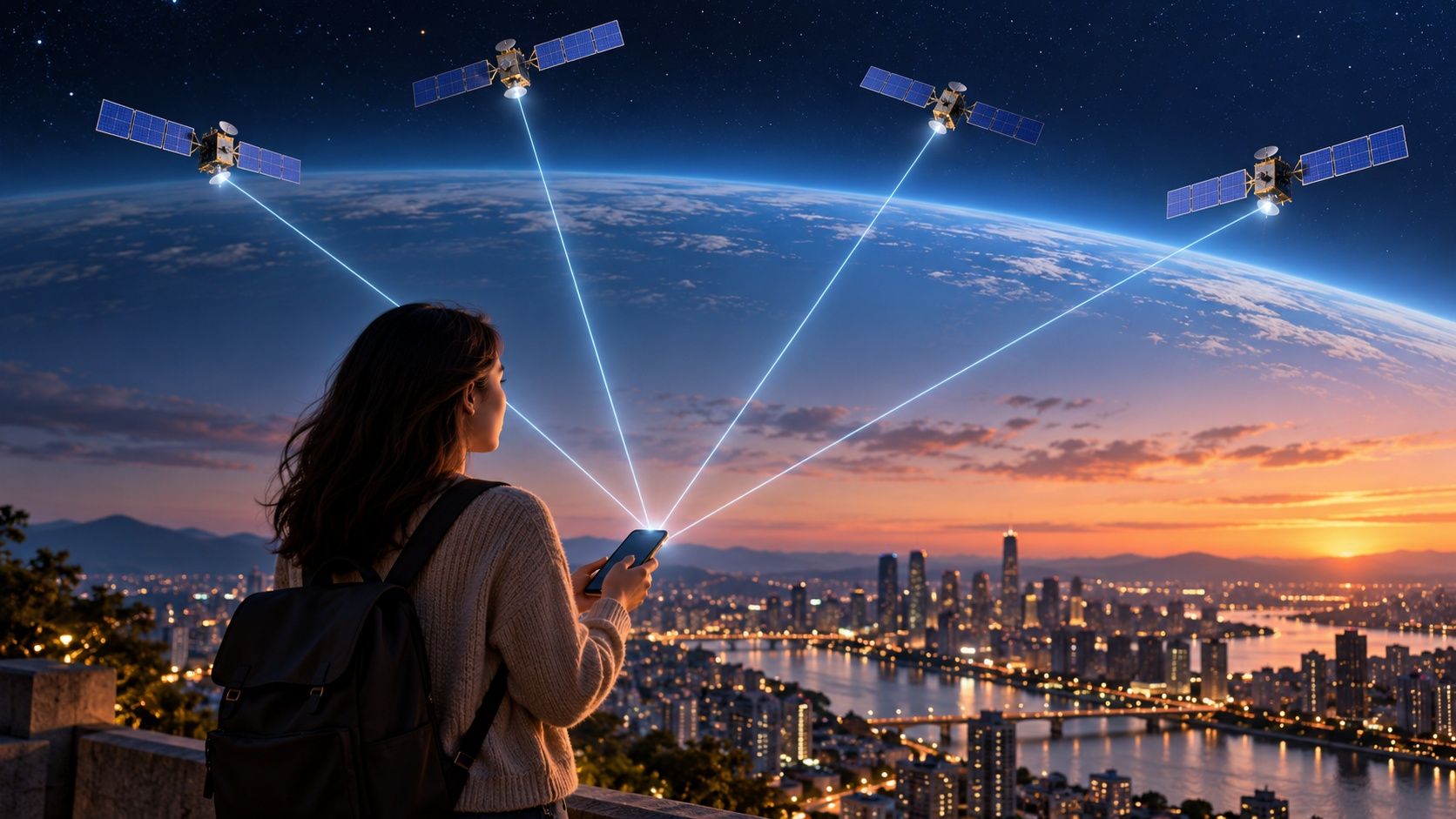
About 30 GPS satellites circle the Earth, each constantly sending out its position and the exact time from an atomic clock. Your phone listens to at least four of them and measures how long each signal took to arrive. From the delays it works out how far away each satellite is, and there is only one spot that fits them all: where you are.
Satellites broadcast the time
Each GPS satellite carries an extremely precise atomic clock. It sends out a constant radio signal saying where it is and exactly what time it was when the signal left.
Share this stepDelay becomes distance
The signals travel at the speed of light, but still take a tiny moment to arrive. Your phone compares the time in the signal with when it arrived. A delay of one thousandth of a second means the satellite is about 300 km away.
Share this stepFour distances, one place
Knowing your distance to one satellite puts you somewhere on a huge sphere. Several spheres only cross at one point. Three are needed for your position, and a fourth to correct your phone’s far less precise clock.
Share this stepGPS is a stopwatch in space.
Time signalsdelaysyour position
Your phone only listens, it never sends anything to the satellites. The clocks are so precise that the system must correct for Einstein’s relativity: without it, positions would drift by several kilometers a day.
Common follow-up questions
Does GPS need internet or mobile data?
No. The satellite signals are free and work anywhere with a view of the sky. Your phone often uses Wi-Fi and cell towers too, to find you faster and work better indoors.
How accurate is phone GPS?
Usually within about 5 meters outdoors. Tall buildings, trees and indoor spaces block or bounce the signals and make it less accurate.
Can someone track me through GPS?
The satellites can’t, because your phone only receives. But apps on your phone can share the location they calculate, which is why it’s worth checking app permissions.
Is GPS the only system?
No. GPS is American. Europe has Galileo, Russia GLONASS and China BeiDou, and most modern phones use several of them at once.