How do self-driving cars work?
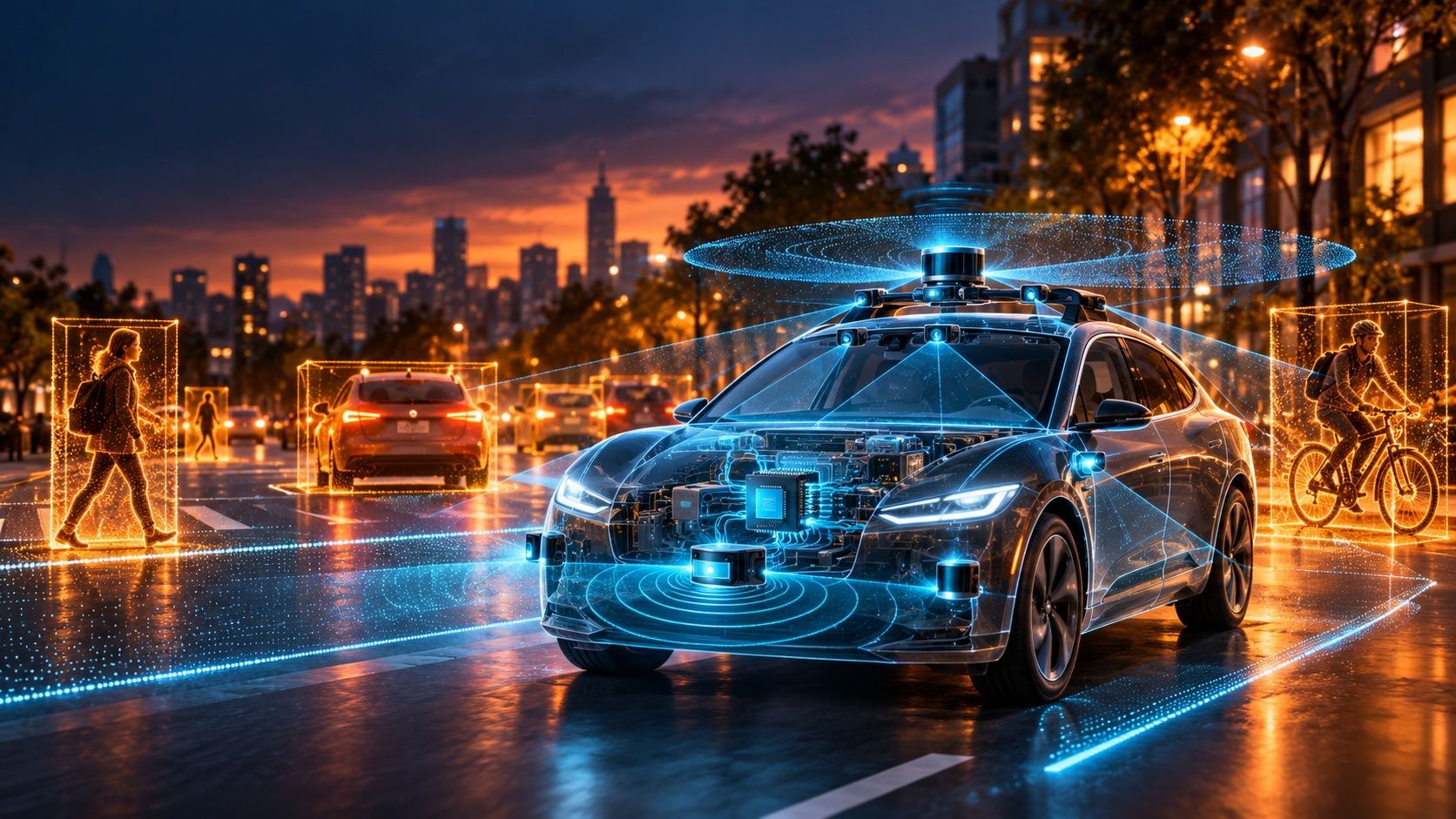
A self-driving car sees with cameras, radar and lidar, a spinning laser. A computer combines the data into a live 3D picture, recognizes people and cars, predicts what they’ll do and steers, brakes and accelerates, many times every second.
A spinning laser maps the world
On the roof, lidar fires invisible laser pulses in every direction and times how long they take to bounce back. That gives millions of distance points every second, a 3D map of everything around the car.
Share this stepCameras and radar fill in the rest
Cameras read lanes, traffic lights and signs. Radar measures distance and speed with radio waves and keeps working in rain, fog and darkness. Each sensor covers the others’ weak spots.
Share this stepIt spots people, bikes and cars
Software trained on huge amounts of driving data marks every object with a box: pedestrian, cyclist, car. It also predicts where each one is likely to move next.
Share this stepThe computer plans and drives
A powerful computer combines everything, picks a safe path and controls steering, brakes and speed. The whole loop, from seeing to acting, repeats many times per second.
Share this stepSee, understand, decide, repeat.
Sensorsrecognitiondriving
Fully driverless taxis already carry passengers in a few cities, mainly in the US and China. Most cars sold today only assist the driver: you still have to watch the road and be ready to take over.
Common follow-up questions
Are self-driving cars safe?
In data published by operators such as Waymo, driverless taxis have had fewer injury crashes than human drivers, but they still make mistakes in unusual situations. The technology is improving and closely regulated.
Can I buy a self-driving car?
Not a fully self-driving one. Systems sold to private buyers, like Tesla’s, still require you to supervise and keep your attention on the road.
What happens in snow or heavy rain?
Bad weather is one of the hardest problems. Snow hides lane markings and rain can confuse lidar and cameras, which is why radar is an important backup.
Who is responsible if a driverless car crashes?
It depends on the system and the country. With driver-assistance systems the driver is responsible. For fully driverless services, the operating company usually is.