How do animals camouflage themselves?
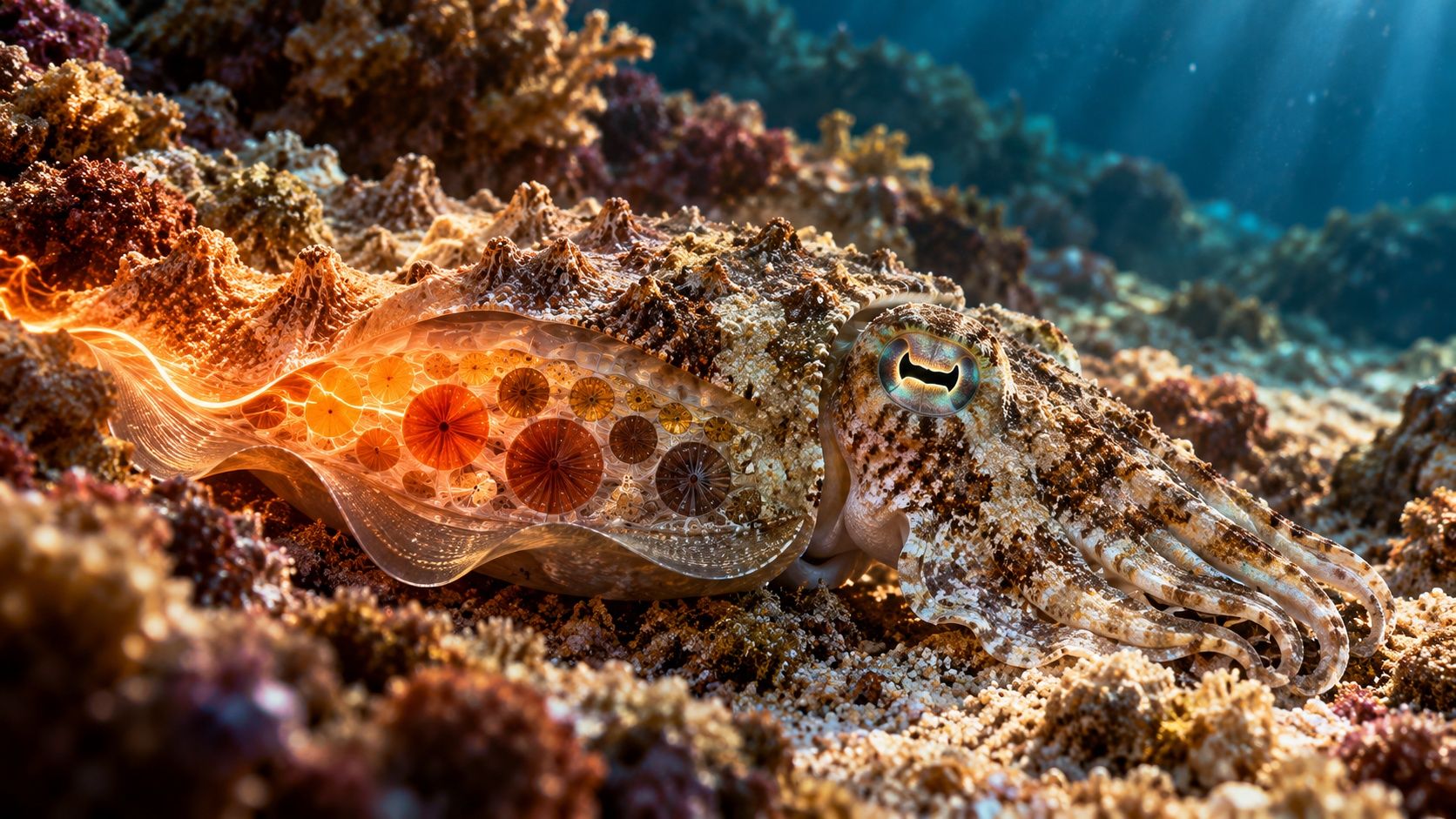
Most animals have fixed colors and patterns that match where they live. But some, like cuttlefish and octopuses, can change in under a second. Their skin is full of tiny bags of color that muscles stretch open or squeeze shut, and they can even raise bumps to copy the texture of rocks and seaweed.
Blending into the background
Camouflage works by fooling the eyes of predators or prey. Most animals rely on fixed colors that match their home, like a striped tiger in tall grass or a brown hare in the forest. The cuttlefish takes it further: it scans its surroundings and copies them.
Share this stepTiny bags of color open and close
The skin is packed with color cells, small elastic bags of pigment. Muscles around each bag pull it wide open to show the color, or let it shrink to a dot. Nerves control them directly from the brain, so the whole pattern can change in a fraction of a second.
Share this stepBumps copy the surface
The cuttlefish can also raise small bumps and spikes in its skin, so it doesn’t just look like the rocks and seaweed, it has the same rough shape. Lying still on the seabed, it practically disappears.
Share this stepHiding in plain sight, in under a second.
Eyescolor cellsinvisible
Oddly, cuttlefish are believed to be colorblind, yet they still match colors well. Scientists are still studying how. Chameleons, by the way, mostly change color to show mood or control temperature, not to hide.
Common follow-up questions
Do chameleons change color to hide?
Mostly not. Their basic colors already blend in, but the changes are mainly for signaling to other chameleons and adjusting body temperature.
Which animals change color with the seasons?
Animals like the mountain hare, the ptarmigan and the arctic fox grow white fur or feathers for winter and turn brown again in summer, so they match the snow and the bare ground.
What is mimicry?
When an animal copies another animal or object instead of the background, like stick insects that look like twigs or harmless flies that look like wasps to scare off birds.
Can octopuses change color too?
Yes, using the same kind of color cells as cuttlefish. Some octopuses can even change shape to imitate other animals.