Why does the Moon change shape?
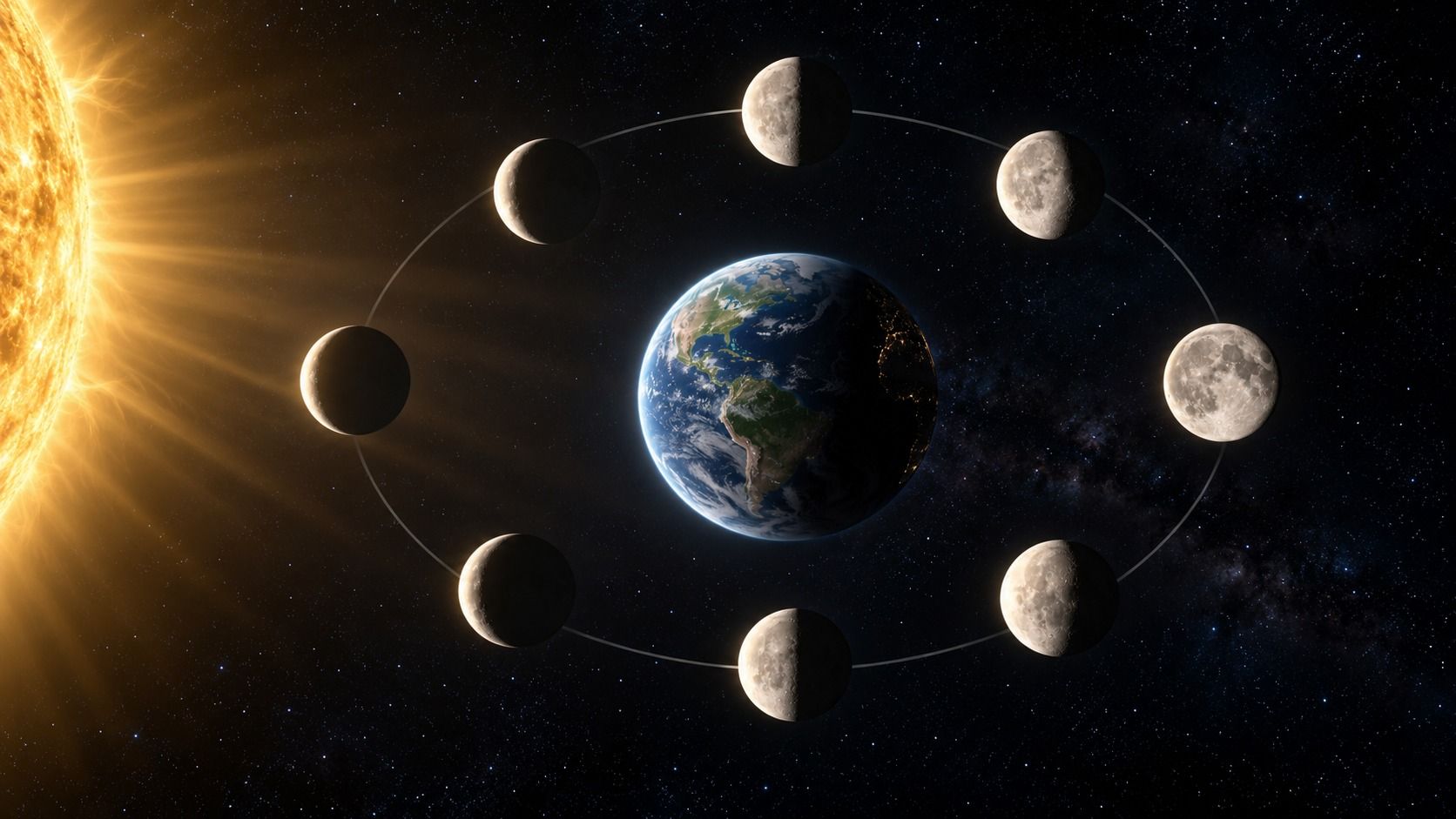
The Moon doesn’t actually change shape. The Sun always lights up half of it, and as the Moon circles Earth over about a month, we see more or less of that sunlit half.
The Sun always lights half the Moon
The Moon makes no light of its own. Like Earth, it’s always half in sunlight and half in darkness, wherever it is in its orbit.
Share this stepBetween us and the Sun: dark
When the Moon sits between Earth and the Sun, its lit side faces away from us. We see only its dark side, and it practically disappears. That’s the new moon.
Share this stepA quarter of the way around: half lit
A week later, the Moon has moved a quarter of the way around Earth. Now we see it from the side, half its sunlit part and half its dark part.
Share this stepBehind Earth: fully lit
About two weeks after the new moon, the Moon is on the far side of Earth. Its entire sunlit face points toward us, and we see a full moon. Then the cycle runs backward.
Share this stepSame Moon, different viewing angle.
Sunlightorbitphases
One full cycle, from new moon to new moon, takes about 29.5 days. That’s where the word “month” comes from. It has nothing to do with Earth’s shadow, which only reaches the Moon during a lunar eclipse.
Common follow-up questions
Is the Moon’s shape caused by Earth’s shadow?
No, that’s a common mix-up. The phases come from the angle we see the sunlit side from. Earth’s shadow only falls on the Moon during a lunar eclipse.
Why do we always see the same side of the Moon?
The Moon spins exactly once for every trip around Earth, so the same face always points toward us.
Can you see the Moon during the day?
Yes, often. Except near the new moon, it’s up during daylight for part of the time, just harder to notice against the bright sky.
Does the Moon look the same everywhere?
The phase is the same, but in the Southern Hemisphere the Moon appears upside down, so the lit side is flipped compared with the Northern Hemisphere.