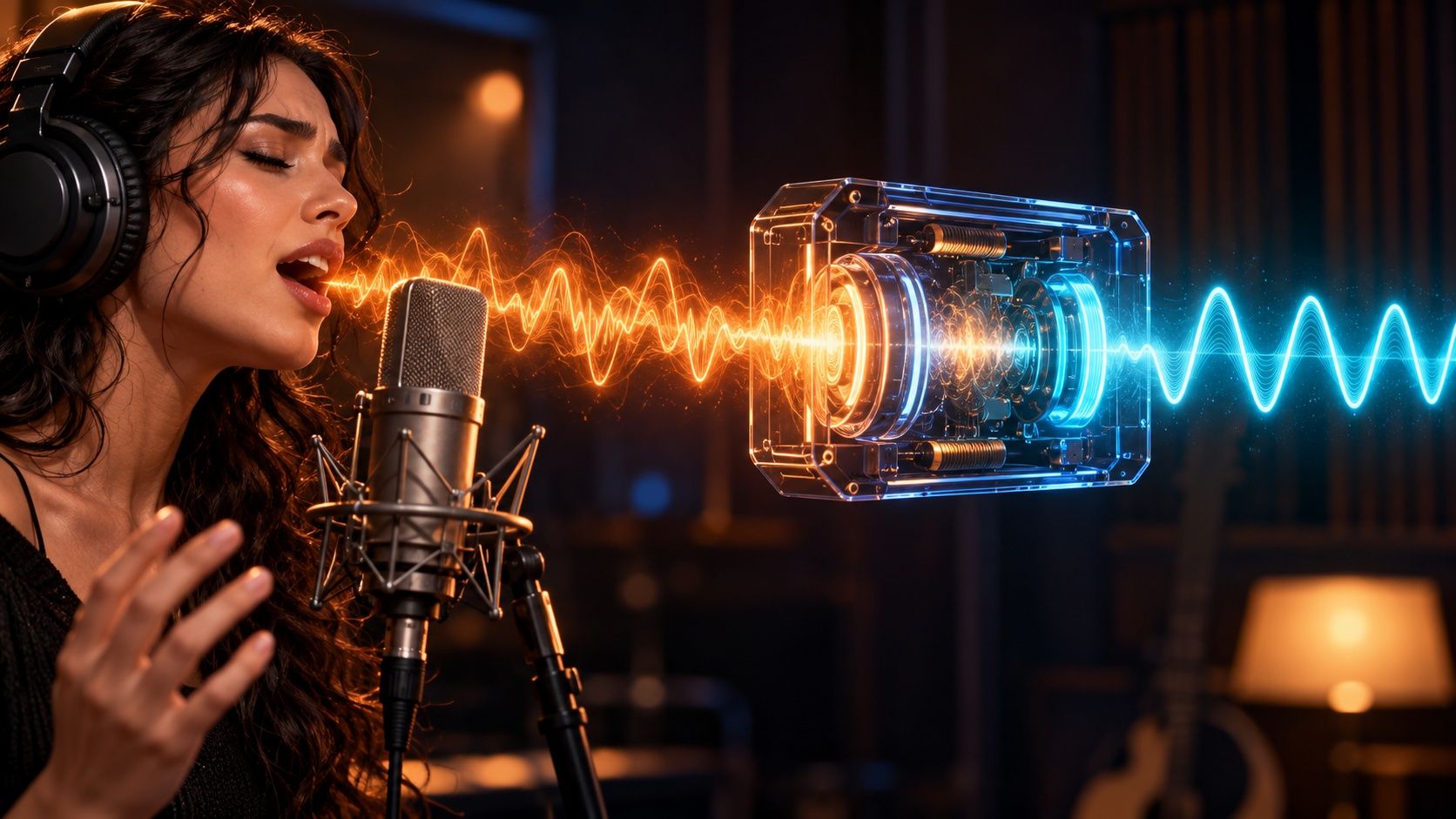
How does Auto-Tune work?
Auto-Tune listens to the voice, measures its pitch many times a second and compares it to the nearest correct note in the song’s key. If the singer is slightly off, it nudges the voice up or down to that note. Set gently it’s barely noticeable, set to maximum it snaps between notes and gives the famous robotic sound.
It measures the pitch
Every note is a vibration with a certain frequency. Auto-Tune analyzes the voice in tiny slices and works out the pitch in each one, many times per second.
Share this stepIt finds the nearest right note
The software knows which notes belong to the song’s key. For each moment it checks which allowed note is closest to what was sung, and how far off the singer is.
Share this stepIt nudges the voice into tune
Then it shifts the pitch to that note, without changing how fast the singer sings. The speed setting decides the sound: slow correction sounds natural, instant correction jumps between notes and creates the robotic effect.
Share this stepA tuner for the voice.
Off-key notenearest right notein tune
Auto-Tune was invented in 1997 by Andy Hildebrand, an engineer who had used similar math to search for oil underground. A year later Cher’s ‘Believe’ turned the robotic setting into a sound of its own.
Common follow-up questions
Do all singers use Auto-Tune?
Many recordings use some pitch correction, often so subtle you can’t hear it. Live, some artists use it too, while others sing without any.
Can Auto-Tune make anyone sound good?
No. It fixes pitch, but not timing, tone, breathing or feeling. A weak voice set to maximum correction just sounds obviously robotic.
What’s the difference between Auto-Tune and pitch correction?
Auto-Tune is a brand name for one product. Pitch correction is the general technique, and there are many similar tools.
How do apps make my voice sound like a famous effect?
Phone apps and video filters use the same idea: they detect the pitch of your voice in real time and snap it to notes or shift it up and down.