How does an e-bike work?
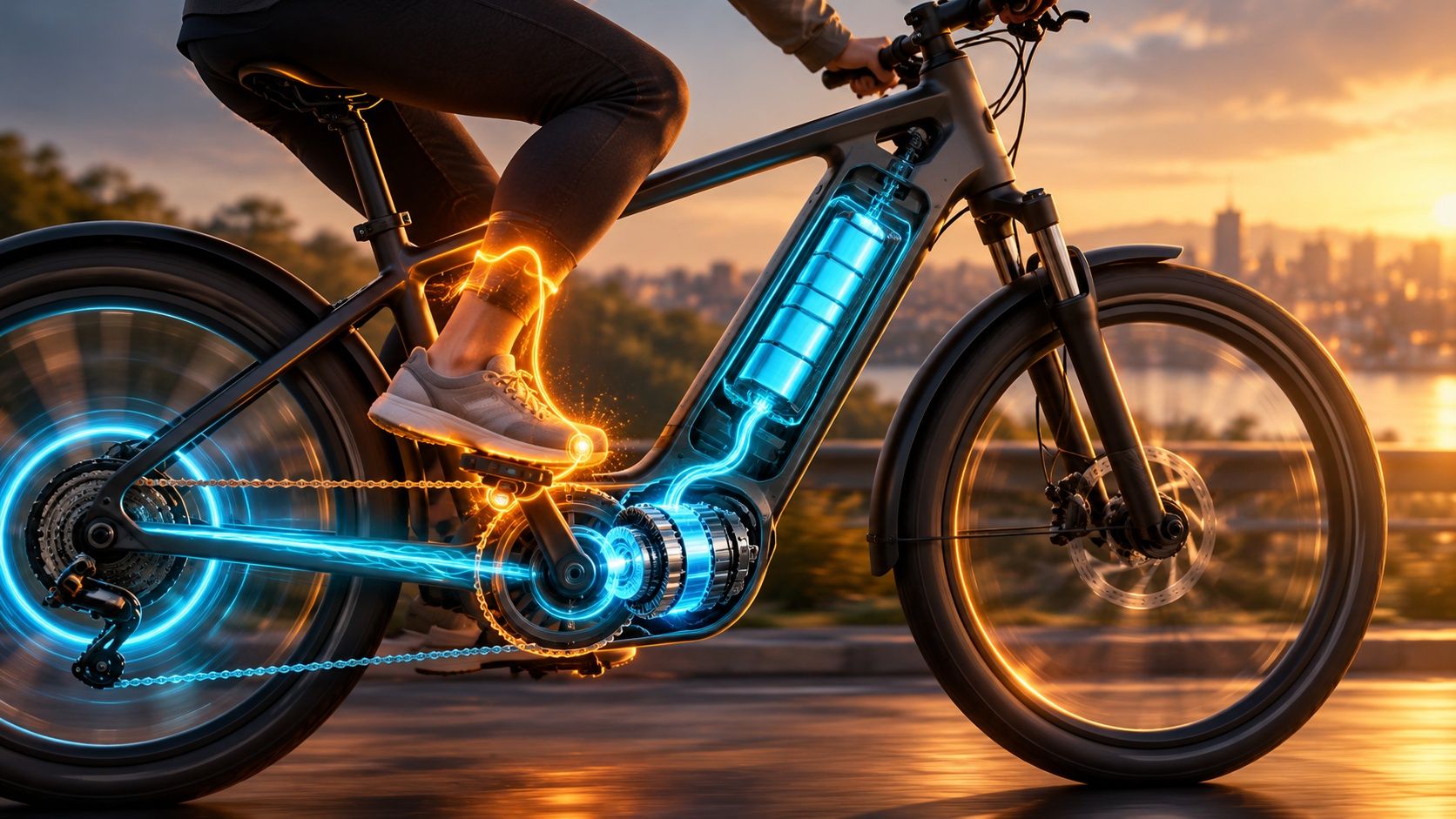
An e-bike is a normal bike with a battery, a motor and a sensor. When you pedal, the sensor measures how hard you push and tells the motor to add extra power. You still have to pedal, but hills and headwinds feel much easier.
A sensor feels you pedal
Near the pedals sits a sensor that measures how hard and how fast you pedal. That’s how the bike knows you want to go, and how much help you need.
Share this stepThe battery sends power down
A rechargeable lithium battery in the frame holds the energy. A small computer reads the sensor and decides how much power to send to the motor, depending on the assist level you’ve chosen.
Share this stepThe motor helps turn the wheel
The motor adds its force to yours, either at the pedals, as here, or in a wheel hub. The chain carries the combined force to the rear wheel, so every push takes you farther.
Share this stepYou pedal, the motor multiplies.
Your pedalingbattery and motoreasy speed
In the EU the motor may only help up to 25 km/h (15.5 mph) and with at most 250 watts of continuous power. Then it legally counts as a regular bicycle. Above that speed, you pedal on your own.
Common follow-up questions
How far can an e-bike go on one charge?
Often 40 to 100 km (25 to 60 miles), depending on the battery, the assist level, hills, wind, weight and the cold.
Does an e-bike charge when you brake or go downhill?
Usually not. Most e-bikes can’t recover energy, the battery is only charged from the wall.
Do I need a license or insurance?
Not in most of Europe, as long as the bike stops helping at 25 km/h and has a maximum of 250 watts. Faster ones count as mopeds and have other rules.
How long does an e-bike battery last?
Usually several years or many hundreds of charges. Store it indoors in winter and avoid leaving it completely empty or fully charged for long periods.